'When I was your age, I always did it for half-an-hour a day. Why, sometimes I've believed as many as six impossible things before breakfast." (The White Queen, Alice in Wonderland)
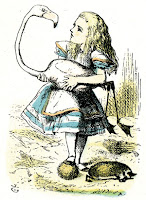 Using your imagination requires a little bit of madness, perfectly exemplified by Lewis Carroll's characters in Alice in Wonderland. Not coincidentally, Carroll was a mathematician; sophisticated mathematics can create seemingly impossible scenarios, where 2 + 2 only equals 4 on alternate Tuesdays, for example. So he knew that believing impossible things was an indispensable creative skill.
The idea is to imagine what the world would be like if the impossible were actually possible. In general it's best to treat this as a thought experiment--out of concern for my readers I wish to emphasize that you can't really sprout wings and fly. On the other hand, you can use your creativity to find a workaround; inventing the airplane, for example, is a real-world way of sprouting wings and flying.
Here's a quick example of how you could use this as a creative exercise. How could it be both cloudy and clear at the same time? Come up with imaginary or realistic scenarios, it doesn't really matter. The idea is to force your brain through the looking glass to a world where more things are possible.
 Using your imagination requires a little bit of madness, perfectly exemplified by Lewis Carroll's characters in Alice in Wonderland. Not coincidentally, Carroll was a mathematician; sophisticated mathematics can create seemingly impossible scenarios, where 2 + 2 only equals 4 on alternate Tuesdays, for example. So he knew that believing impossible things was an indispensable creative skill.
The idea is to imagine what the world would be like if the impossible were actually possible. In general it's best to treat this as a thought experiment--out of concern for my readers I wish to emphasize that you can't really sprout wings and fly. On the other hand, you can use your creativity to find a workaround; inventing the airplane, for example, is a real-world way of sprouting wings and flying.
Here's a quick example of how you could use this as a creative exercise. How could it be both cloudy and clear at the same time? Come up with imaginary or realistic scenarios, it doesn't really matter. The idea is to force your brain through the looking glass to a world where more things are possible.


